The Mercedes intralogistics project was designed as an end-to-end management system for transferring electronic assemblies and large interior upper-panel parts from the pre-assembly area to the final production line. The objective was not simply to call an AGV from one point to another. The project required a decision layer that could manage line-side stock areas, generate tasks according to the real rhythm of production, communicate with the robot fleet, and coordinate shared traffic zones with other autonomous vehicle systems.
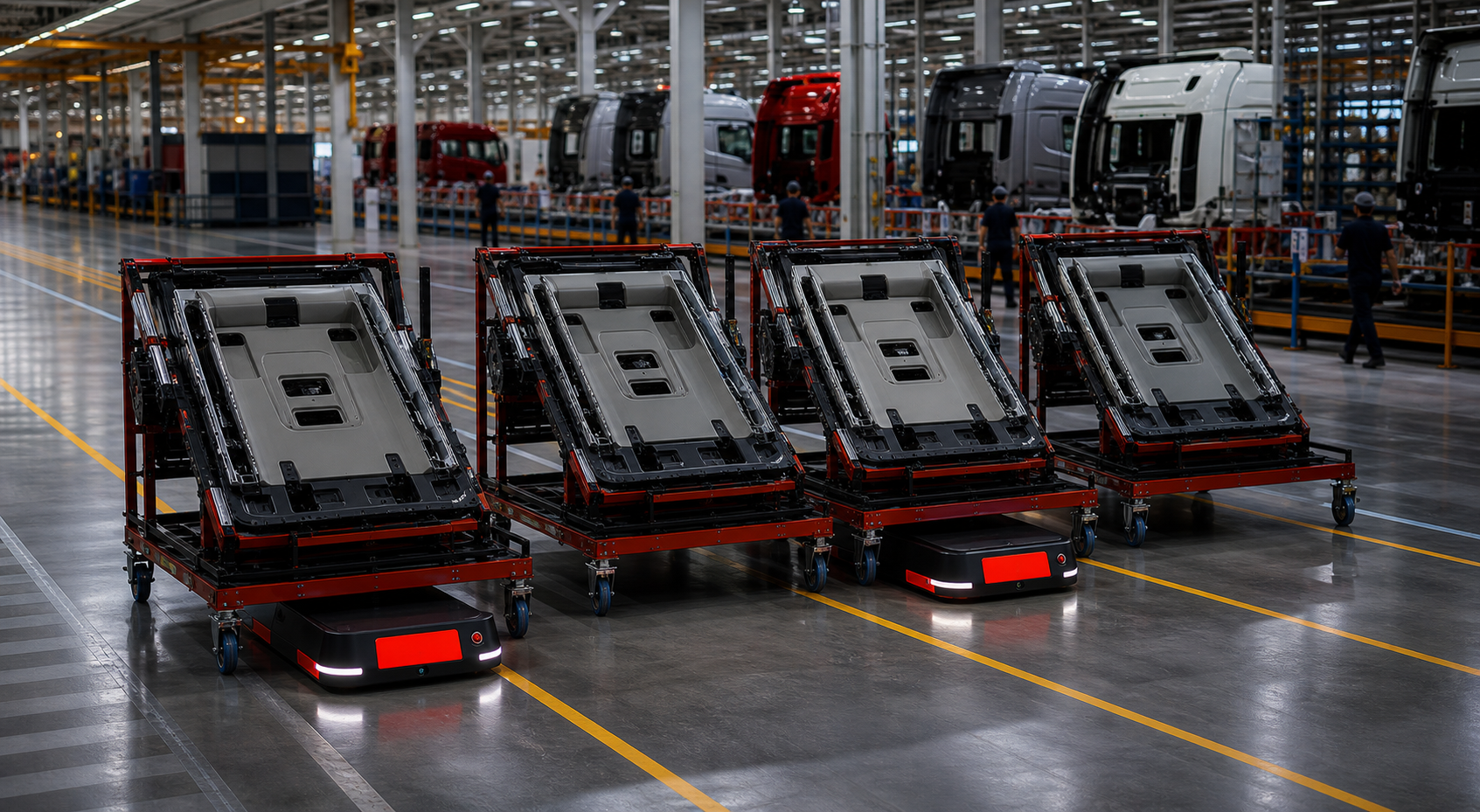
The material flow starts in the pre-assembly area, where large electronic and interior roof-panel assemblies are prepared and loaded onto special transport carts. These carts are then delivered to four separate mounting points on the serial production line, where the parts are installed onto truck cabins. Every movement is tracked as part of a managed operation: which cart carries which part, which stock area it came from, which mounting point it must reach, and which robot is responsible for the transfer.
Project Scope
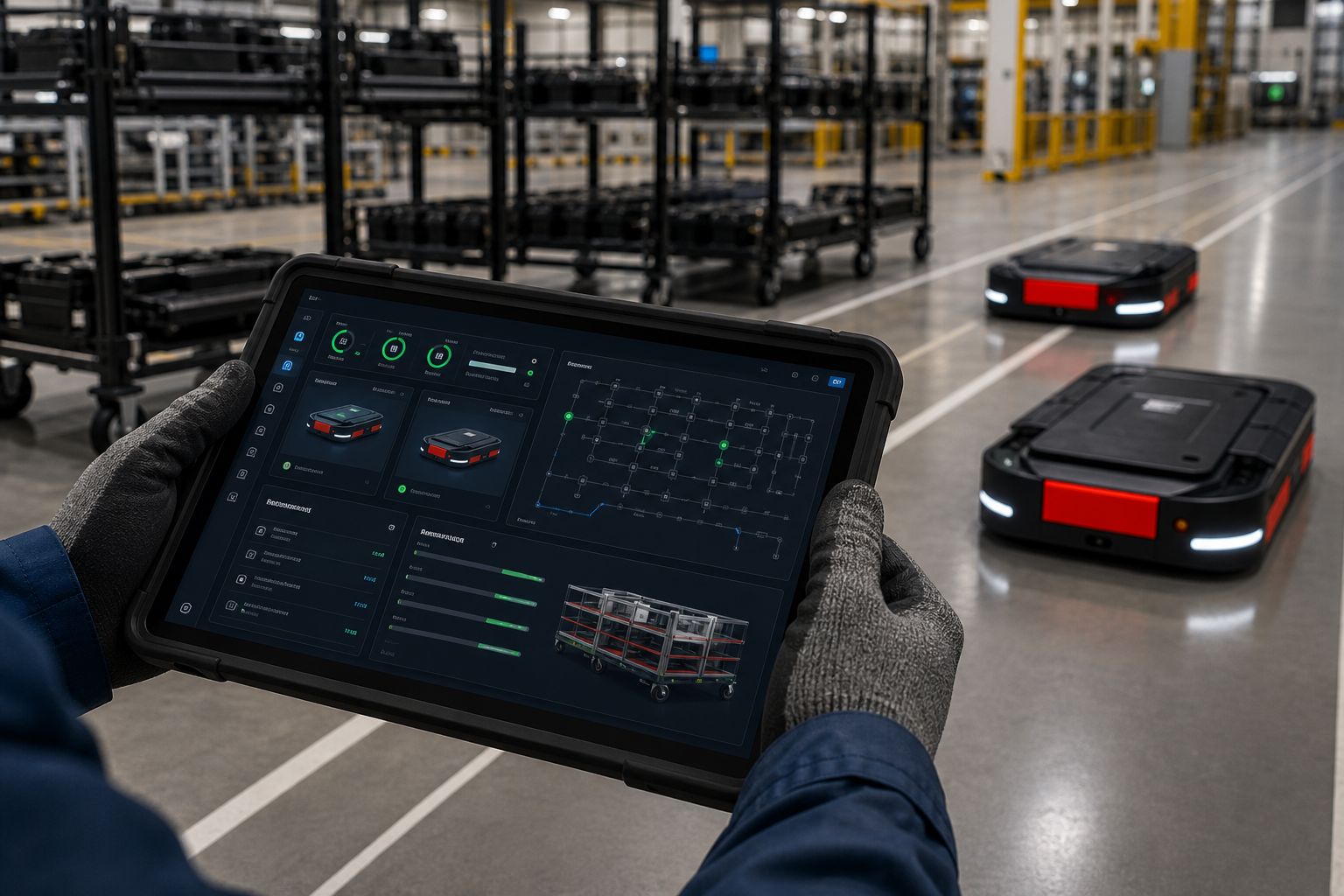
The system brought together a desktop client, Android tablet clients, stock-area management, robot task generation, two on-site Hikrobot LMR robots with RCS integration, real-time AGV status monitoring, charging commands, and traffic-management integration. The desktop client became the planning and control surface for operations, while the tablet client gave floor teams a mobile way to monitor AGV status, check battery levels, and send available robots to charge when needed.
This was deliberately broader than a simple robot-dispatch screen. The management layer evaluated cart locations, waiting areas, final assembly delivery points, robot availability, and the state of shared traffic areas before releasing tasks. Each task became part of a controlled production flow rather than a one-off movement command with only an origin and a destination.
From Pre-Assembly to the Production Line
The parts prepared in pre-assembly must reach truck cabins on the production line in a strict operational sequence. Their size and handling requirements make cart order and line-side timing critical. Four special transport carts can wait side by side or in sequence, and the system knows which part is on each cart and which station on the production line must receive it.
The four line-side mounting points were modeled as separate delivery locations. Tasks are released in relation to line tempo and part readiness. This prevents carts from arriving too early and crowding the line, while also reducing the risk of late deliveries that would force assembly teams to wait. In practice, the system acts as an execution layer that aligns physical transfer work with the pace of production.
Hikrobot LMR and RCS Integration
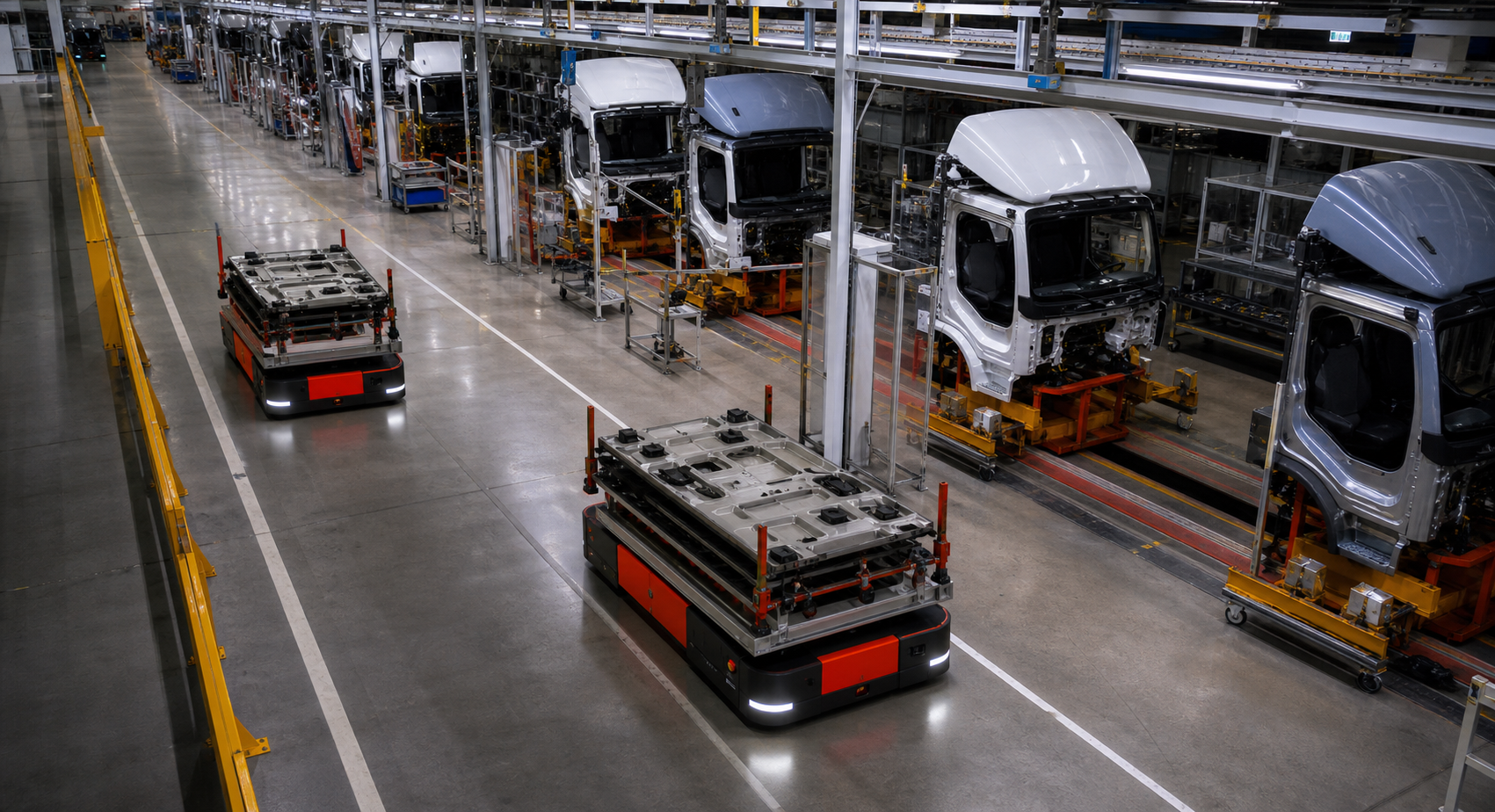
The robot layer was integrated with two on-site Hikrobot LMR robots and the RCS system. The Visetra management system produces the operational task, while RCS handles robot routing, movement, and low-level execution on the floor. This separation was essential: RCS decides how the robot moves, while the Visetra layer decides which work should be done, when it should be released, and how it fits into the wider production flow.
Before a task is sent to RCS, the system evaluates robot availability, cart position, target assembly point, stock-area state, and shared-zone availability. After dispatch, task state continues to be monitored: accepted, moving, arrived at pickup, waiting for shared-zone permission, crossing, delivered, returning empty, or charging. This gives operations a detailed view of the live material flow.
The value of the integration was not limited to API connectivity. The physical process had to be modeled correctly in software. A single transfer requirement was decomposed into multiple operational steps, each with its own preconditions, safety checks, and completion signals.
Stock Area and Special Transport Cart Management
One of the core components of the project was system-managed stock areas. The software keeps track of where carts are waiting, which carts are full or empty, which parts are ready to move to the line, and which areas are available to receive new material. This reduces manual tracking and lets transport decisions be made from reliable real-time data.
Stock areas were treated not as passive parking spaces, but as active buffers in the production flow. When a cart is full, it is associated with a part and a target station. When an empty cart returns, it becomes available for reuse. When a stock area is full, that condition is considered before new tasks are generated. In this way, the robots become part of line synchronization and stock governance, not just transport devices.
Desktop and Android Tablet Clients
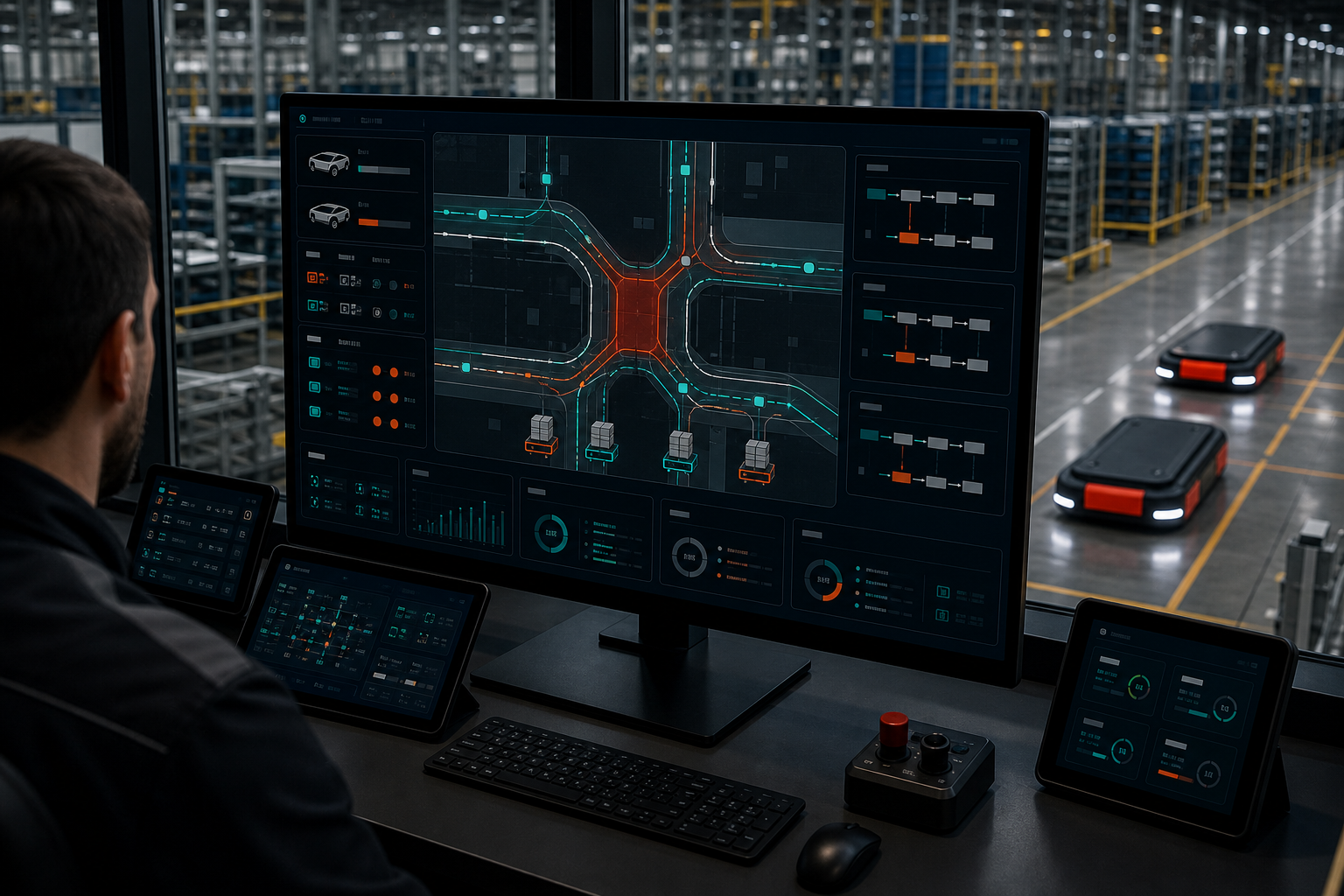
The desktop client was designed as the central planning and control interface. Users can monitor cart states, stock areas, target delivery points, active tasks, robot task history, and exception states. The interface makes the production flow visible with operational context rather than presenting only a raw list of robot jobs.
The Android tablet client was built for mobile use by floor teams. Operators can see AGV status, battery level, current task, and availability directly from the tablet. When needed, an available robot can be sent to charge without returning to a fixed workstation. This is especially valuable for shift teams who move across the line and need quick access to fleet status from the floor.
Traffic Management Integration
The most critical part of the project was traffic-management integration. The facility included shared areas used not only by Hikrobot LMR robots, but also by Robos AIV vehicles. Allowing different autonomous systems to enter these zones without coordination would create unacceptable safety and continuity risks. For that reason, shared-zone entry, exit, close, and evacuation processes were integrated at system level.
The shared area was modeled as a managed software resource, not merely as a physical corridor or intersection. Before a robot enters, the system checks whether the area is available. If the area is closed or currently controlled by the Robos AIV flow, the entry task waits. When the zone becomes available, the task is released to the next step. This creates a controlled handover mechanism between autonomous systems from different vendors.
Modeling entry, exit, close, and evacuation as distinct processes was important. Entry permission is evaluated before the robot moves into the shared area. Exit notification confirms that the robot has safely left the zone. Close scenarios are used when the area must be temporarily blocked. Evacuation handles cases where the shared area must be cleared safely before normal operation can continue.
Segmented Task Structure
The traffic integration required tasks to be structured as segmented workflows. A simple transfer was divided into pickup, approach to shared zone, wait for entry permission, shared-zone crossing, exit notification, delivery to target point, and empty return. This made the task controllable at the exact moments where safety and coordination mattered most.
Segmented tasks also improved exception handling. If a robot waits before the shared area, the system can distinguish between a normal permission wait and a real blockage. If a close command is triggered while a task is active, the system does not have to cancel the whole operation blindly; it can move the task into a safe wait, reroute, or recovery state. This reduces uncontrolled manual intervention and helps protect line continuity.
Operational Outcome
The final system made the material flow between pre-assembly and final assembly more visible, controlled, and scalable. Special transport cart status, robot position, task step, stock-area availability, and shared-zone state were brought into a single management logic. Instead of relying on fragmented screens and manual checks, the intralogistics flow is governed by a software layer that understands the state of the floor.
The project demonstrates that the real value in AGV and AMR integration is not only in moving robots, but in producing the right tasks according to the rhythm of production. Desktop and tablet clients gave different teams the same real-time operational picture. Traffic integration and segmented task design made it possible for autonomous vehicle systems from different ecosystems to operate safely in the same production environment.